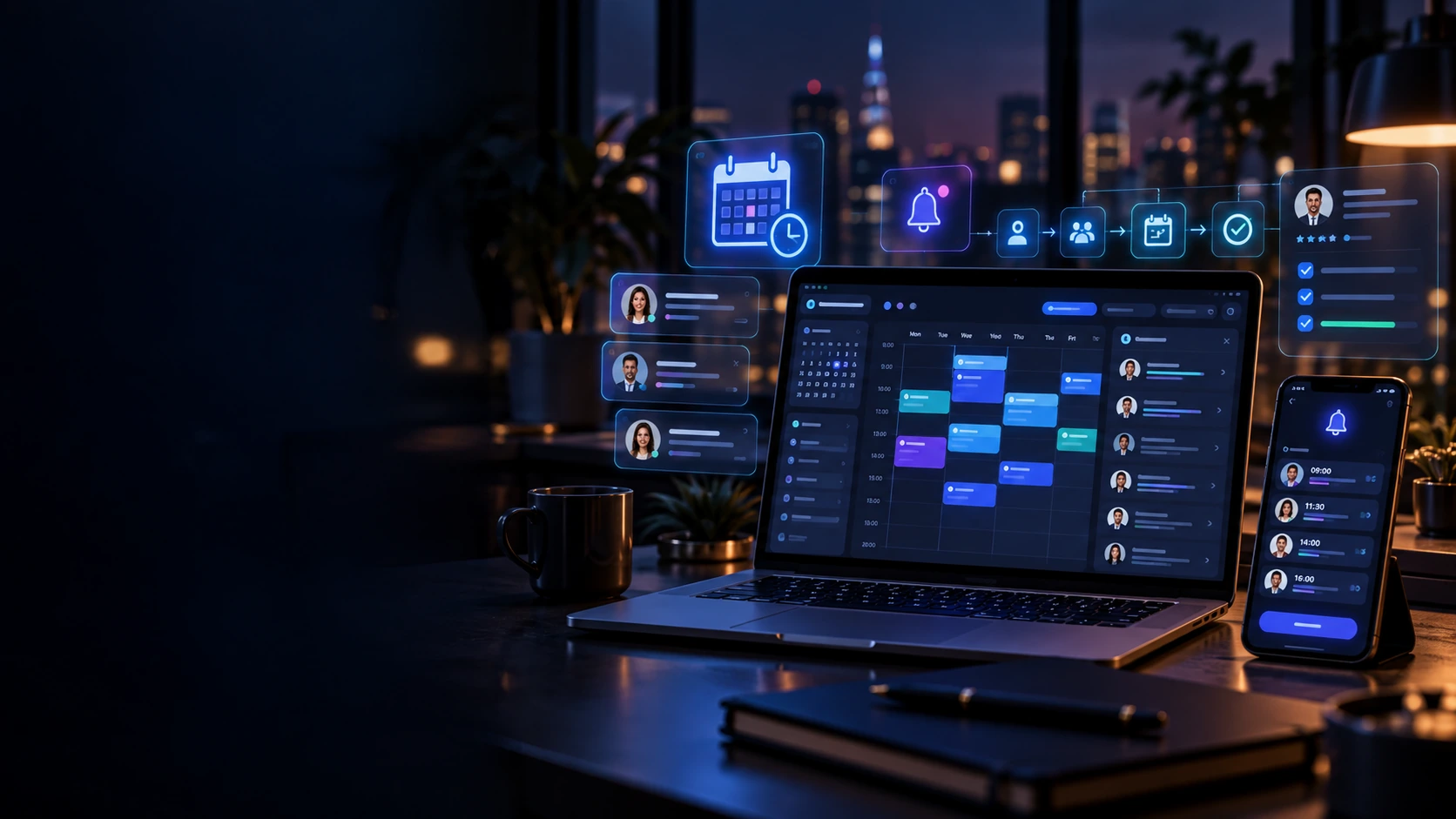
What arrives outside office hours
A request received on a Friday night usually waits until Monday, by which time the sender may well have approached other providers.

Support, lead capture, appointments and follow-up
We organise the complete flow of a request —intake, record, pending data, appointment and follow-up— so nothing depends on someone remembering and every case is traceable.
The problem
They come in fine, get handled halfway and sit waiting for a piece of data, a confirmation or a call nobody made again.
A request received on a Friday night usually waits until Monday, by which time the sender may well have approached other providers.
“We had to call this one.” “That one still had to send us something.” It is a method that stops being reliable when volume grows or a team member is missing.
Some are noted in a notebook, others sit in an email and others exist only in the memory of whoever handled them. There is no way to see at a glance how many are open.
What we do
The aim is not to add another tool, but for every request to follow the same route, with defined control points, and leave a traceable record.
Requests received outside working hours receive a first response through the service channel, whether the website, WhatsApp or Nova, and are logged.
Everything that arrives is collected with the same structure, whichever channel it comes from.
Appointments, bookings and confirmations are recorded with their details, not on a loose note.
Reminders and notices are sent according to defined rules, without depending on someone remembering.
What is waiting for a piece of data is flagged, with the person who must resolve it.
Follow-up starts with the information the customer has already given, without asking again.
Each request keeps its context, so whoever picks it up doesn't start from zero.
The team can see what is open and what the next step is, without rebuilding the picture every morning.
How it applies
Real situations, told as they happen. These are not customer cases or measured results: they are examples of use.
Beauty salon
Hypothetical scenario: an appointment request arrives on a Sunday. It is recorded with the service, preferred time and telephone number, so that on Monday it only needs confirming.
Installer
A quote is waiting for the customer to send a photo. The pending item is flagged and the reminder goes out within the agreed timeframes, with no manual follow-up.
Restaurant
Hypothetical scenario: bookings arrive through several channels and are logged in a single place, in the same format, with an alert for those not yet confirmed.
What we need from you
Even if right now you keep appointments on paper or in your head. The first step works with your current way of working: we organise intake and recording, and the diary or system comes in later, in phases, if it's worth it. What we do need to know is what information is needed to provide the service and what decides that a request is complete.
When a person steps in
Organising the circuit doesn't mean closing appointments automatically. Confirming real availability needs a reliable data source to consult; until one exists in your case, the system collects and prepares the request, and someone on the team confirms it. When that source exists, it is connected, but we don't take it for granted before reviewing it.
If the answer is “we'd have to check”, that is the problem. Tell us how they come in and how you follow them today, and we'll see which part can stop depending on memory.
Other services that often go with this one
Nova · My NovaGen AI
You are talking to Nova, our virtual AI agent. To reply to you, your messages are sent to OpenAI, the provider of the model that generates Nova's replies, which may keep security records under its own terms. Do not share passwords, bank details or sensitive information. For privacy queries, write to info@mynovagenai.com. Virtual AI agent · OpenAI · Don't share sensitive data · Privacy (in Spanish)